
The 1990 Quarter: Routine Issue or Sleeper Candidate?
Standard production of 25-cent coins in 1990 followed the established Washington quarter program guidelines.
Lacking commemorative dates, this period utilized the classic obverse and reverse designs.
Numismatic evaluation of the mintage relies on physical surface preservation and technical striking deviations.
Massive production volume ensured high liquidity for common examples while creating a deficit of coins in elite grades.
This analysis provides data regarding the market 1990 quarter value, production volumes, and factors determining asset pricing.
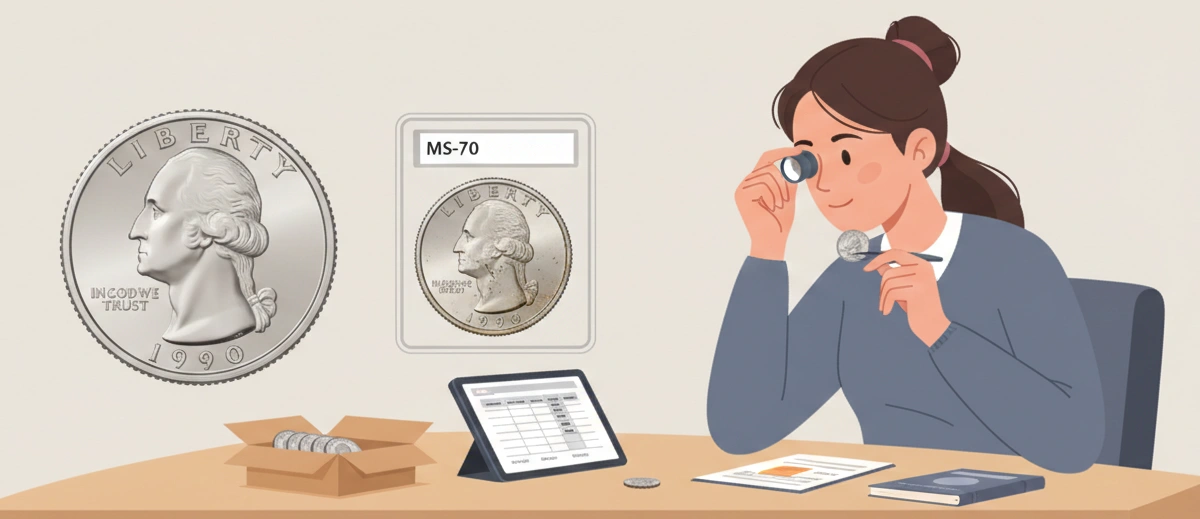
Characteristic | Value |
Weight | 5.67g |
Diameter | 24.26mm |
Cladding Composition | 75% Copper, 25% Nickel |
Core Composition | 100% Copper |
Edge Type | Reeded |
Production Statistics by Mint Facility
Mintage in 1990 was distributed among three primary production sites.
The Philadelphia Mint produced coins marked with the P mint mark, while Denver utilized the D mark.
The San Francisco facility specialized in producing Proof sets designated by the S mark.
1990 Mintage Volume Data
Location | Mark | Mintage |
Philadelphia | P | 613,792,000 |
Denver | D | 927,638,181 |
San Francisco | S | 3,296,504 |
Total production volume exceeding 1.5 billion units precludes the possibility of scarcity for standard circulation coins.
High availability results in 98% of existing specimens being valued at face value.
MS67 and MS68 Grades
Market value for the 1990 quarter demonstrates a sharp increase upon reaching the highest tiers of the Sheldon scale.
The price gap between MS65 and MS67 grades exceeds 3000%.
Pricing is primarily driven by the rarity of coins lacking contact marks sustained during automated bagging processes.
Auction Records and Market Prices
Strike Type | Grade | Realized Price | Sale Date |
1990-D Regular | MS68 | $1,350 | 2019 |
1990-P Regular | MS67 | $550 | 2021 |
1990-S Proof | PR70 DCAM | $425 | 2017 |
1990-P Regular | MS66 | $15 | 2023 |
The value for coins in MS63 condition does not exceed $1.
Specimens in MS65 grade trade within a $5–$8 range.
Annual price changes for MS67 category coins over the last 7 years averaged +2.4%.
Conversely, the value of standard MS60 coins decreases by 3% annually relative to US dollar purchasing power.
Survival Statistics (Population Report)
Data from major grading services PCGS and NGC confirm the low probability of locating perfect coins.
Technological processes in 1990 did not prioritize gentle transport of mintages.
Damage occurring during coin drops into bins makes MS68 grades an exceptional occurrence.
Registry of Confirmed Grades (2025 Data)
Philadelphia in MS67 grade: 114 units
Denver in MS67 grade: 210 units
Denver in MS68 grade: 2 units
San Francisco in PR70 grade: 145 units
Discovery of a third 1990-D specimen in MS68 grade will cause a 15–20% price decline for existing rarities.
Investment significance of these objects stems from their uniqueness within official registries.
Confirmed Error Types and Striking Defects
The market for production errors functions independently from the standard grade sector.
Value of defective coins is determined by the technical complexity of the machinery malfunction.
These objects retain value even when showing signs of circulation.
Classification of 1990 Defects
Wrong Planchet Error. Striking on 1-cent or 10-cent blanks resulting in weight and diameter changes.
Off-center Strike. Lack of alignment between the planchet and the dies, measured by the percentage of displacement.
Double Die. Repeated pressure from the press on a planchet failing to exit the striking zone.
Lamination. Peeling of the upper nickel layer exposing the copper core due to metal impurities.
A 1990-P quarter with 40% off-center displacement is valued at $180–$250.
Specimens featuring deep die cracks on the obverse trade at $30–$55.
Investment Yield of Annual Mint Sets
The Mint sold 1,809,184 uncirculated coin sets in 1990.
Initial set pricing was $7.00.
Current secondary market value fluctuates between $5.50 and $8.00.
Investment returns for 1990 Mint Sets over 35 years remain negative when adjusted for inflation.
Purchasing uncertified sets as a capital preservation method is statistically inefficient.
Extracting quarters from sets remains the only method for obtaining MS66 grades or higher.
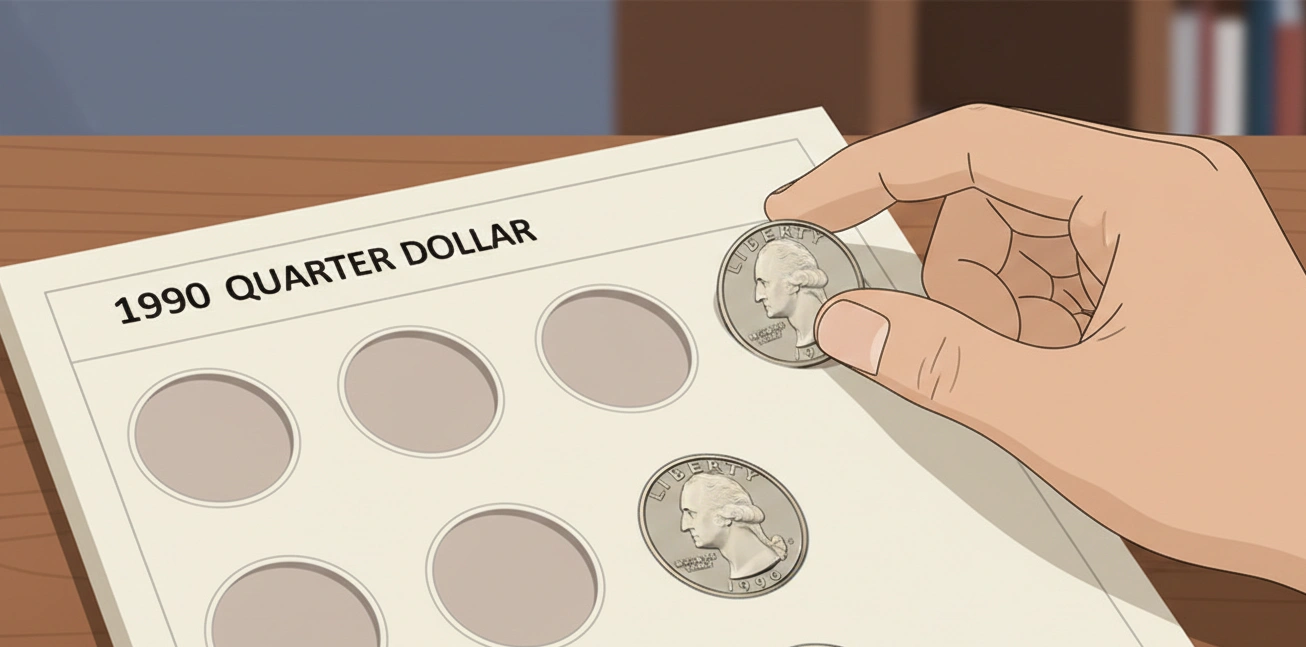
Grading as a Capital Protection Tool
Acquiring a 1990 quarter without a protective slab from an expert company involves financial risk.
Microscopic damage undetectable during standard inspection reduces the score by 2-3 grades.
Professional certification through PCGS or NGC is a mandatory requirement for selling a coin above $100.
Grading procedures confirm authenticity and stabilize surface condition.
Permissible weight wear for circulated coins reaches up to 0.15 grams.
1990 Condition Assessment Criteria
MS60: Presence of visible scratches and absence of original mint luster
MS63: Contact marks appearing on Washington’s cheek and eagle details
MS65: Preservation of mint strike structure with minimal field damage
MS67: Visual surface clarity maintained under tenfold magnification
Operating Costs of Numismatic Transactions
Investing in a 1990 quarter requires analysis of associated expenses.
Certification services for a single coin cost $30–$65 including membership fees.
Transportation and insurance during shipping increase cost basis by 12%.
Auction commissions during asset liquidation range from 15–22% of the total.
Reaching a break-even point is only possible with a 45% price increase from the purchase date.
For the 1990 issue, such dynamics are exclusively characteristic of rare error varieties.
Factors of Collectible Asset Devaluation
Chemical cleaning of the surface destroying original luster
Mechanical edge defects resulting from improper storage
Copper core oxidation during contact with humid environments
Deep contact marks present on the obverse portrait
Artificial toning applied to hide surface defects